



Invest
Homebuyers challenged by ‘severely undersupplied’ housing markets
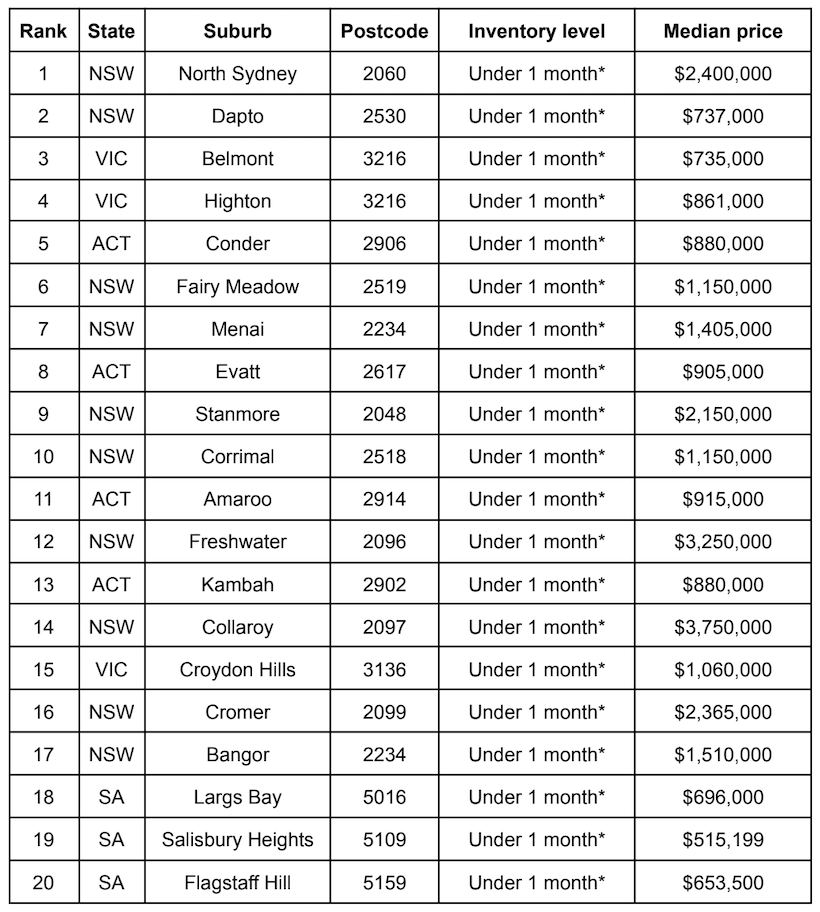
A new report has identified the 20 suburbs hit hardest by housing undersupply.
Homebuyers challenged by ‘severely undersupplied’ housing markets

Aussies looking to enter the property market in the nation’s most undersupplied housing markets are now facing significantly higher prices and increased competition.
Inventory levels are currently under one month in each of the top 20 undersupplied housing markets identified in a new report from HOOD.ai, with levels declining in 13 of the 20 markets during the past year.
Stock turnover levels, or the estimated share of houses in a suburb that sold during the past year, were under 4.9 per cent in 14 of the 20 markets, below the median for suburbs within 200km of a capital city.
The most undersupplied suburb in the country was found to be North Sydney with a median price of $2.4 million and stock turnover of 1.1 per cent.

“Part of the reason Australia has been experiencing a property boom is because stock levels have been low, which has forced buyers to compete harder and bid up prices,” said HOOD.ai founder and CEO Tommy Fraser.
“That story has really played out in these 20 suburbs, where inventory levels have been incredibly low over the past year. As a result, the median house price of most of these suburbs has experienced a double-digit percentage increase over the past year.”
Ten of the 20 most undersupplied housing markets were in NSW, including Dapto in second position with a median price of $737,000 and stock turnover of 4.2 per cent.
Meanwhile, four of the top 20 suburbs were in the ACT, three were in South Australia and a further three were in Victoria.
“Buyers desperately need new stock to come onto the market in all these suburbs, because right now, they’re in a terrible bind,” Mr Fraser said.
“When a house comes onto the market, do they offer a fair price and risk missing out? Or do they do whatever it takes to win the property but overpay?”
The suburb of Belmont in Victoria had a median price of $735,000 and stock turnover of 5.0 per cent, ranking as the third most undersupplied housing market in Australia.
Conder was the most undersupplied market in the ACT and the fifth most undersupplied nationally with a median price of $880,000 and stock turnover of 5.4 per cent.
In South Australia, the housing market of Largs Bay recorded a median price of $696,000 and stock turnover of 3.4 per cent, the most undersupplied suburb in the state and 18th nationally.
“It would be great to return to a balanced market, where owners enjoy reasonable capital growth and buyers have a reasonable chance of finding a property in their chosen suburb,” concluded Mr Fraser.
“For that to happen, these 20 suburbs need to see a significant increase in new listings.”

Property
Zagga's ninth anniversary sees focus on investor education in real estate private credit
In a significant milestone, Zagga, a key player in the Australian real estate sector, is celebrating its ninth anniversary with a renewed commitment to investor education. The company has grown ...Read more

Property
Australian property’s quiet pivot: resilience hides a new competitive map
Australia’s housing market remains sturdier than the macro noise suggests, but the sources of resilience have shifted. For operators, the profit pool is migrating from ‘volume at any price’ to ...Read more

Property
Gen Z’s 5% deposit rush: how policy‑driven demand is reshaping Australia’s housing value chain
A government-backed 5% deposit guarantee has triggered a surge in first-home buyer intent among Gen Z, pulling forward demand and resetting competition across banks, brokers and buildersRead more

Property
Cautious bidders, smarter sellers: a Queensland auction case study on repricing risk
Queensland’s auction market has hit a caution cycle as buyers price in higher borrowing costs, global uncertainty and cost-of-living pressure. Clearance softness is forcing agencies to re-engineer ...Read more

Property
Trust, technology and triage: what NSW’s ‘name and shame’ signals for real estate governance
NSW’s latest enforcement action on real estate trust accounts isn’t a one-off embarrassment; it’s a stress test of sector governance. With licences suspended and penalties applied, the message is ...Read more

Property
Vacancy is rising, demand is resilient: A case study in defending yield as Australia’s rental cycle rebalances
After a blistering run, Australia’s rental market is loosening at the edges. Vacancy is edging up off historic lows, rent inflation is set to moderate into 2026, yet underlying demand remains ...Read more

Property
Don’t lose the deposit: A case study in stopping real estate payment fraud — and the ROI for doing it
Deposit redirection scams are quietly eroding buyer savings and agency reputations in Australia’s property market. This case study unpacks how a mid-tier real estate group redesigned its settlement ...Read more

Property
The $12m threshold: Why portfolio value, not property count, now defines Australia’s investor elite
The old yardstick of six properties as shorthand for investment success has been overtaken by a harsher reality: in today’s market, elite status is defined by balance-sheet strength, not asset countRead more
Property
Zagga's ninth anniversary sees focus on investor education in real estate private credit
In a significant milestone, Zagga, a key player in the Australian real estate sector, is celebrating its ninth anniversary with a renewed commitment to investor education. The company has grown ...Read more
Property
Australian property’s quiet pivot: resilience hides a new competitive map
Australia’s housing market remains sturdier than the macro noise suggests, but the sources of resilience have shifted. For operators, the profit pool is migrating from ‘volume at any price’ to ...Read more
Property
Gen Z’s 5% deposit rush: how policy‑driven demand is reshaping Australia’s housing value chain
A government-backed 5% deposit guarantee has triggered a surge in first-home buyer intent among Gen Z, pulling forward demand and resetting competition across banks, brokers and buildersRead more
Property
Cautious bidders, smarter sellers: a Queensland auction case study on repricing risk
Queensland’s auction market has hit a caution cycle as buyers price in higher borrowing costs, global uncertainty and cost-of-living pressure. Clearance softness is forcing agencies to re-engineer ...Read more
Property
Trust, technology and triage: what NSW’s ‘name and shame’ signals for real estate governance
NSW’s latest enforcement action on real estate trust accounts isn’t a one-off embarrassment; it’s a stress test of sector governance. With licences suspended and penalties applied, the message is ...Read more
Property
Vacancy is rising, demand is resilient: A case study in defending yield as Australia’s rental cycle rebalances
After a blistering run, Australia’s rental market is loosening at the edges. Vacancy is edging up off historic lows, rent inflation is set to moderate into 2026, yet underlying demand remains ...Read more
Property
Don’t lose the deposit: A case study in stopping real estate payment fraud — and the ROI for doing it
Deposit redirection scams are quietly eroding buyer savings and agency reputations in Australia’s property market. This case study unpacks how a mid-tier real estate group redesigned its settlement ...Read more
Property
The $12m threshold: Why portfolio value, not property count, now defines Australia’s investor elite
The old yardstick of six properties as shorthand for investment success has been overtaken by a harsher reality: in today’s market, elite status is defined by balance-sheet strength, not asset countRead more