




Invest
10 years on, here’s where you should have bought
According to new figures, one Melbourne suburb has seen property values increase by 130 per cent in 10 years. In other news, hindsight is a beautiful thing.
10 years on, here’s where you should have bought

According to new figures, one Melbourne suburb has seen property values increase by 130 per cent in 10 years. In other news, hindsight is a beautiful thing.

The latest CoreLogic Home Value Index data has shone a light on the Australian regions that have seen the greatest increase in dwelling values in the decade to October 2017.
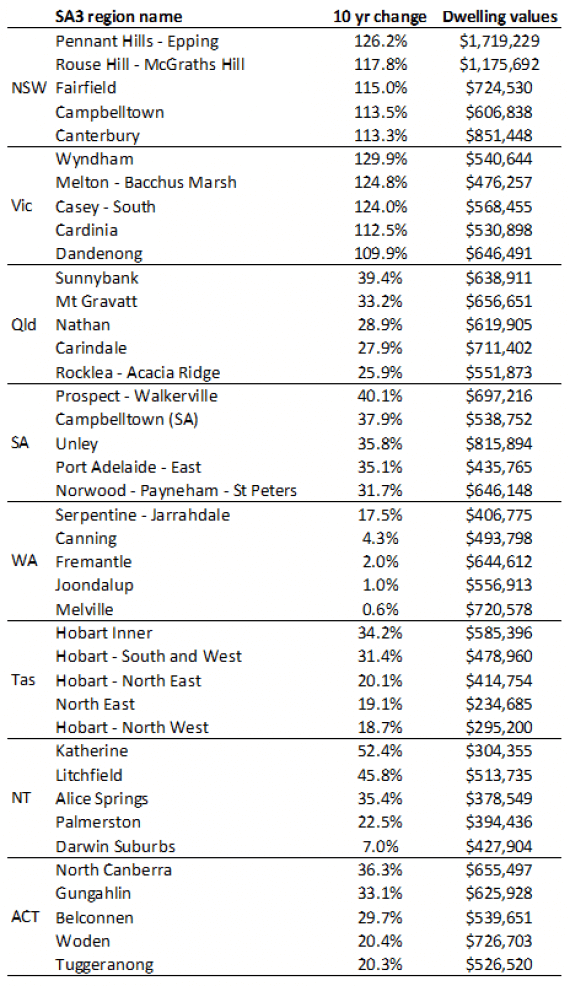
The number one suburb was Wyndham in Victoria where the current $540,644 value reflects a whopping 129.9 per cent increase.
The outer south-western Melbourne region has seen “substantial new housing development” occur in the past 10 years.
Close behind Wyndham is the Pennant Hills – Epping region in Sydney. A 126.2 per cent increase has seen the average dwelling value shoot to $1.7 million.
The figures also provide insight into the relative strength of the housing markets in different states.
With the strongest suburb in Western Australia (Serpentine-Jarrahdale) recording an increase of just 17.5 per cent and the fifth strongest (Melville) up just 0.6 per cent, the numbers highlight “just how weak the housing market in Perth has been over the past decade, despite the mining boom supporting strong capital gains over the first half of the decade”, CoreLogic analyst Cameron Kusher said.
“When analysing the regions with the greatest value increases, the top 10 regions nationally are all located in either Sydney or Melbourne while Katherine in the Northern Territory is the only region outside of NSW or Victoria to have recorded value growth in excess of 50 per cent (52.4 per cent) over the past decade.
“This highlights how much stronger value growth has been in Sydney and Melbourne relative to other capital cities over the past decade.”
The number one suburb in Queensland, Sunnybank saw an increase of 39.4 per cent to $638,911, while the top South Australia region (Prospect – Walkerville) jumped 40.1 per cent to $697,216.
Hobart Inner in Tasmania saw prices increase by 34.2 per cent to $585,396 and dwelling values in North Canberra in the ACT grew by 36.3 per cent to $655,497.
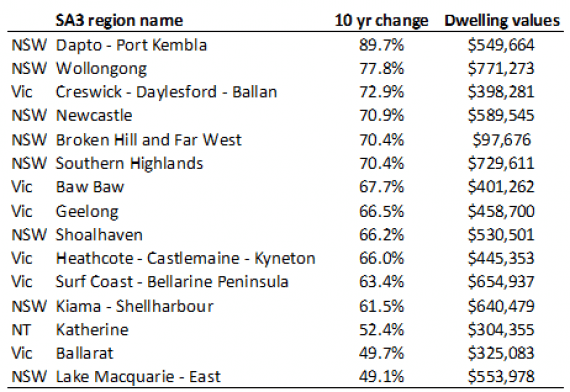
Mr Kusher continued: “The top five list for each state and territory shows a significant slant towards capital city regions rather than regional housing markets. In fact, only Katherine and Alice Springs make the list for the top five in each state and territory outside of a capital city.
“Overall the data highlights the strength of value growth in Sydney and Melbourne over recent years. Furthermore, it details just how moderate growth has generally been outside of these two cities.”
However, he noted that Sydney and Melbourne together account for about 40.3 per cent of the national population and 58.3 per cent of the total value of dwellings across the country.
“Given this, it really highlights the extent to which the performance of the Sydney and Melbourne housing markets will drive the national headline growth figures.”
Here's the full list:
Regions in each state with the greatest increase in dwelling values, decade to October 2017
Non-capital city regions with the greatest increase in dwelling values, decade to October 2017
RELATED ARTICLES

Property
Cautious bidders, smarter sellers: a Queensland auction case study on repricing risk
Queensland’s auction market has hit a caution cycle as buyers price in higher borrowing costs, global uncertainty and cost-of-living pressure. Clearance softness is forcing agencies to re-engineer ...Read more

Property
Trust, technology and triage: what NSW’s ‘name and shame’ signals for real estate governance
NSW’s latest enforcement action on real estate trust accounts isn’t a one-off embarrassment; it’s a stress test of sector governance. With licences suspended and penalties applied, the message is ...Read more

Property
Vacancy is rising, demand is resilient: A case study in defending yield as Australia’s rental cycle rebalances
After a blistering run, Australia’s rental market is loosening at the edges. Vacancy is edging up off historic lows, rent inflation is set to moderate into 2026, yet underlying demand remains ...Read more

Property
Don’t lose the deposit: A case study in stopping real estate payment fraud — and the ROI for doing it
Deposit redirection scams are quietly eroding buyer savings and agency reputations in Australia’s property market. This case study unpacks how a mid-tier real estate group redesigned its settlement ...Read more

Property
The $12m threshold: Why portfolio value, not property count, now defines Australia’s investor elite
The old yardstick of six properties as shorthand for investment success has been overtaken by a harsher reality: in today’s market, elite status is defined by balance-sheet strength, not asset countRead more

Property
From intuition to instrumentation: How a "two-stakeholder" sales playbook lifted close rates and cut cycle times
High-stakes consumer purchases are increasingly joint decisions. When one partner is under-served, deals stall. This case study follows an Australian real estate group that rebuilt its sales motion ...Read more

Property
Selling in 2025: How to spot bad agents fast—and build an ROI-first vendor playbook
In Australia’s property market, choosing the wrong listing agent isn’t just inconvenient—it’s a textbook principal–agent failure that can wipe tens of thousands off your sale outcomeRead more

Property
Selling in 2026: How to de‑risk your agent choice and protect tens of thousands at settlement
Choosing the wrong selling agent isn’t just an inconvenience — it’s a balance‑sheet risk. In a market where digital discovery is concentrated and AI is recasting how listings are priced and promoted, ...Read more
Property
Cautious bidders, smarter sellers: a Queensland auction case study on repricing risk
Queensland’s auction market has hit a caution cycle as buyers price in higher borrowing costs, global uncertainty and cost-of-living pressure. Clearance softness is forcing agencies to re-engineer ...Read more
Property
Trust, technology and triage: what NSW’s ‘name and shame’ signals for real estate governance
NSW’s latest enforcement action on real estate trust accounts isn’t a one-off embarrassment; it’s a stress test of sector governance. With licences suspended and penalties applied, the message is ...Read more
Property
Vacancy is rising, demand is resilient: A case study in defending yield as Australia’s rental cycle rebalances
After a blistering run, Australia’s rental market is loosening at the edges. Vacancy is edging up off historic lows, rent inflation is set to moderate into 2026, yet underlying demand remains ...Read more
Property
Don’t lose the deposit: A case study in stopping real estate payment fraud — and the ROI for doing it
Deposit redirection scams are quietly eroding buyer savings and agency reputations in Australia’s property market. This case study unpacks how a mid-tier real estate group redesigned its settlement ...Read more
Property
The $12m threshold: Why portfolio value, not property count, now defines Australia’s investor elite
The old yardstick of six properties as shorthand for investment success has been overtaken by a harsher reality: in today’s market, elite status is defined by balance-sheet strength, not asset countRead more
Property
From intuition to instrumentation: How a "two-stakeholder" sales playbook lifted close rates and cut cycle times
High-stakes consumer purchases are increasingly joint decisions. When one partner is under-served, deals stall. This case study follows an Australian real estate group that rebuilt its sales motion ...Read more
Property
Selling in 2025: How to spot bad agents fast—and build an ROI-first vendor playbook
In Australia’s property market, choosing the wrong listing agent isn’t just inconvenient—it’s a textbook principal–agent failure that can wipe tens of thousands off your sale outcomeRead more
Property
Selling in 2026: How to de‑risk your agent choice and protect tens of thousands at settlement
Choosing the wrong selling agent isn’t just an inconvenience — it’s a balance‑sheet risk. In a market where digital discovery is concentrated and AI is recasting how listings are priced and promoted, ...Read more