



Invest
Wait, so it’s definitely cheaper to rent than buy?
New research has revealed that there are indeed dwellings in Australia that are cheaper to buy than rent (57 per cent to be exact), but where are these dwellings located and are they liveable?
Wait, so it’s definitely cheaper to rent than buy?
New research has revealed that there are indeed dwellings in Australia that are cheaper to buy than rent (57 per cent to be exact), but where are these dwellings located and are they liveable?

According to REA’s inaugural Insights Buy or Rent Report, it is cheaper to buy than rent more than half of properties in Australia, thanks to the Reserve Bank and its low-rate perseverance.
And while results naturally differ by property type, REA’s research – which hinges on current prices and a 10-year analysis of all the costs associated with buying and renting – concludes that just over half of houses are cheaper to buy over the next 10 years, while this rings true for as many as 75 per cent of units.
So, where are these lucky suburbs?
Naturally, REA found that buying conditions are “particularly favourable” outside of NSW and Victoria.
Additionally, (surprise, surprise) more than 80 per cent of houses, and almost all units outside of the most populous states, are estimated to be cheaper to buy than rent.
But they won’t remain “affordable” for long, realestate.com.au economist Paul Ryan believes.
“Affordability is driving demand, and as a result it is likely we will continue to see regional price growth,” Mr Ryan said.
“Interest rates can currently be fixed below 2 per cent per year, and the Reserve Bank of Australia has committed to maintaining low interest rates until at least 2024.
“This certainty that mortgage costs are not going to increase rapidly provides comfort to buyers borrowing larger amounts.”
Where, where, where?
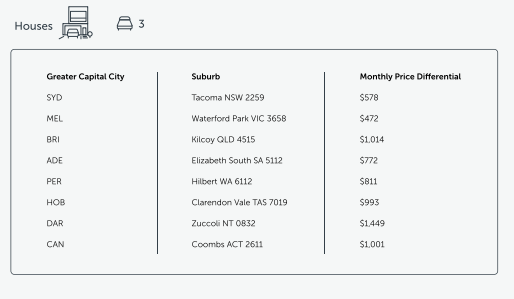
Well, if you currently live in Sydney and are eager to get out and buy a three-bedroom home, then look no further than Tacoma!
Tacoma?
Tacoma is a suburb of the Central Coast region of NSW and, according to REA, it would be $578 per month cheaper to buy rather than rent a three-bedroom house, based on the 10-year analysis.
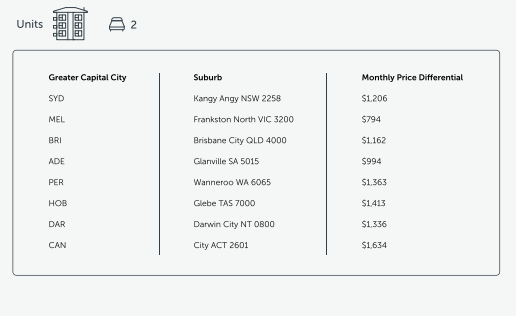
Not interested in three-bedroom homes but prefer a unit? Kangy Angy is your town!
On the Central Coast and in a semi-rural area, Kangy Angy’s monthly price difference sits at $1,206.
Still not enticed?
Well, according to Mr Ryan, for first-time buyers in Sydney, apartments in middle and outer suburban regions are generally cheaper to buy than rent.
“Families looking for more space will find it only marginally more expensive to buy a house outside of inner-city Sydney regions,” he said.
In Melbourne, Victoria’s centrally located Waterford Park is your best bet for three-bedroom homes, while Frankston North is the place REA believes you should look for a comfortable two-bedroom unit.
In Brisbane, the top suburb for its house affordability is regional Kilcoy – 75km northwest of Brisbane – and for a unit (a familiar suburb!) Brisbane City.
But REA’s analysis showed some of the biggest savings from buying instead of renting a house can be found in Western Australia’s Pilbara region, where rents in mining towns have “skyrocketed” amid a boom in iron ore exports.
Among them is Tom Price (over 1,000 km from Perth), offering the biggest monthly saving nationally at $3,341 if buying instead of renting a three-bedroom house.
Buying rather than renting a two-bedroom unit in the Karratha suburb of Pegs Creek (again, very rural!) would be $2,507 a month cheaper.
Renting still cheaper?
But despite a heap of research, REA still arrives at the conclusion that renting remains the cheapest option for many people, particularly in Sydney and Melbourne.
It shows 71.6 per cent per cent of houses in NSW and Victoria and 41.6 per cent of units are estimated to be cheaper to rent than buy over the next decade.
“While rents do not typically adjust as quickly as prices, the COVID-19 pandemic and the cessation of international travel saw significant reductions in asking rents in inner-city Sydney and Melbourne,” Mr Ryan said.
“As such, renting in these inner-city areas is currently considered cheap, relative to their very high asking prices.”
So, the choice is yours, where do you want to live?
About the author

About the author

Property
Zagga's ninth anniversary sees focus on investor education in real estate private credit
In a significant milestone, Zagga, a key player in the Australian real estate sector, is celebrating its ninth anniversary with a renewed commitment to investor education. The company has grown ...Read more
Property
Australian property’s quiet pivot: resilience hides a new competitive map
Australia’s housing market remains sturdier than the macro noise suggests, but the sources of resilience have shifted. For operators, the profit pool is migrating from ‘volume at any price’ to ...Read more

Property
Gen Z’s 5% deposit rush: how policy‑driven demand is reshaping Australia’s housing value chain
A government-backed 5% deposit guarantee has triggered a surge in first-home buyer intent among Gen Z, pulling forward demand and resetting competition across banks, brokers and buildersRead more

Property
Cautious bidders, smarter sellers: a Queensland auction case study on repricing risk
Queensland’s auction market has hit a caution cycle as buyers price in higher borrowing costs, global uncertainty and cost-of-living pressure. Clearance softness is forcing agencies to re-engineer ...Read more

Property
Trust, technology and triage: what NSW’s ‘name and shame’ signals for real estate governance
NSW’s latest enforcement action on real estate trust accounts isn’t a one-off embarrassment; it’s a stress test of sector governance. With licences suspended and penalties applied, the message is ...Read more

Property
Vacancy is rising, demand is resilient: A case study in defending yield as Australia’s rental cycle rebalances
After a blistering run, Australia’s rental market is loosening at the edges. Vacancy is edging up off historic lows, rent inflation is set to moderate into 2026, yet underlying demand remains ...Read more

Property
Don’t lose the deposit: A case study in stopping real estate payment fraud — and the ROI for doing it
Deposit redirection scams are quietly eroding buyer savings and agency reputations in Australia’s property market. This case study unpacks how a mid-tier real estate group redesigned its settlement ...Read more

Property
The $12m threshold: Why portfolio value, not property count, now defines Australia’s investor elite
The old yardstick of six properties as shorthand for investment success has been overtaken by a harsher reality: in today’s market, elite status is defined by balance-sheet strength, not asset countRead more
Property
Zagga's ninth anniversary sees focus on investor education in real estate private credit
In a significant milestone, Zagga, a key player in the Australian real estate sector, is celebrating its ninth anniversary with a renewed commitment to investor education. The company has grown ...Read more
Property
Australian property’s quiet pivot: resilience hides a new competitive map
Australia’s housing market remains sturdier than the macro noise suggests, but the sources of resilience have shifted. For operators, the profit pool is migrating from ‘volume at any price’ to ...Read more
Property
Gen Z’s 5% deposit rush: how policy‑driven demand is reshaping Australia’s housing value chain
A government-backed 5% deposit guarantee has triggered a surge in first-home buyer intent among Gen Z, pulling forward demand and resetting competition across banks, brokers and buildersRead more
Property
Cautious bidders, smarter sellers: a Queensland auction case study on repricing risk
Queensland’s auction market has hit a caution cycle as buyers price in higher borrowing costs, global uncertainty and cost-of-living pressure. Clearance softness is forcing agencies to re-engineer ...Read more
Property
Trust, technology and triage: what NSW’s ‘name and shame’ signals for real estate governance
NSW’s latest enforcement action on real estate trust accounts isn’t a one-off embarrassment; it’s a stress test of sector governance. With licences suspended and penalties applied, the message is ...Read more
Property
Vacancy is rising, demand is resilient: A case study in defending yield as Australia’s rental cycle rebalances
After a blistering run, Australia’s rental market is loosening at the edges. Vacancy is edging up off historic lows, rent inflation is set to moderate into 2026, yet underlying demand remains ...Read more
Property
Don’t lose the deposit: A case study in stopping real estate payment fraud — and the ROI for doing it
Deposit redirection scams are quietly eroding buyer savings and agency reputations in Australia’s property market. This case study unpacks how a mid-tier real estate group redesigned its settlement ...Read more
Property
The $12m threshold: Why portfolio value, not property count, now defines Australia’s investor elite
The old yardstick of six properties as shorthand for investment success has been overtaken by a harsher reality: in today’s market, elite status is defined by balance-sheet strength, not asset countRead more