

Invest
Is your SMSF portfolio really diversified?
Diversification is an important consideration for an SMSF trustee when formulating the fund’s investment strategy. Here we take a look at what that means in practical terms.
Is your SMSF portfolio really diversified?
Diversification is an important consideration for an SMSF trustee when formulating the fund’s investment strategy. Here we take a look at what that means in practical terms.
Alongside ensuring the SMSF is maintained for the sole purpose of providing retirement benefits to its members, SMSF trustees are obliged to consider diversification as a part of their fund’s written investment strategy.
Why diversification is important for SMSFs
Diversification aims to spread your SMSF’s investment risk so that if one asset performs below expectations, the performance of other assets can offset this and keep your fund on track to meet its investment objectives.
Diversifying across uncorrelated assets, such as shares and bonds, also makes it possible for investors to lower the volatility of the portfolio.

The idea here is that because these asset classes typically move in different directions in response to a certain scenario, such as an interest rate move, the portfolio can generate more consistent returns.
Investing across asset classes can also help with another thing trustees must consider – namely liquidity, or how easily the fund’s assets can be converted into cash.
SMSFs need ready access to cash so they can pay administrative expenses, income tax and minimum pensions when they are due. So, it’s probably best not to have all your fund investments in fixed assets, such as property.
In addition, there are some important risks, such as sequencing risk, that can be minimised through a well thought out diversification process.
What does a diversified SMSF portfolio look like?
For SMSFs, the obligation to consider diversification is commonly expressed as a target allocation for each asset class and the acceptable range of variation from this target.
This then provides a relatively simple way to see how the portfolio aligns with the guidelines set out in the investment strategy.
Within large APRA-regulated super funds, asset allocation will change periodically throughout a member’s life depending on how close they are to retirement, when reliability of income increases in importance. SMSFs would be wise to follow this lead.
Generally, however, while the proportions may change there will typically be a mix of cash, fixed interest, property and infrastructure, Australian shares, and global shares.
The chart below shows these asset classes and their sub categories, which represent different methods of gaining access to them. 
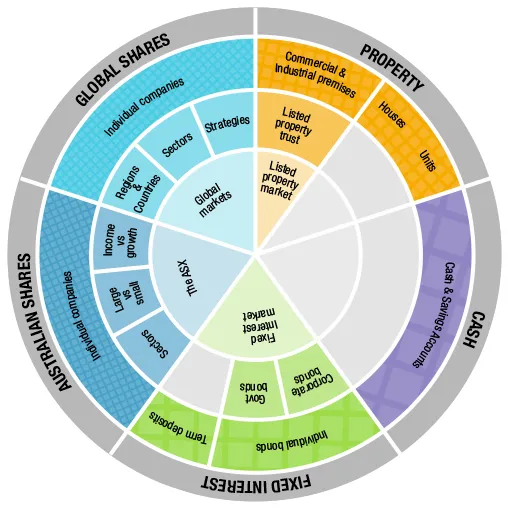
Importantly, diversification is both allocating among a range of asset classes, and then also diversifying within each asset class.
- Diversification between asset classes involves having an asset allocation that consists of a range of different asset classes.
- Diversification within asset classes involves having a range of different investments in each asset class.
How can you make sure you are diversified?
Accessing some of these asset classes can present challenges to individual investors and SMSFs because they may have minimum investment requirements, or other ownership restrictions that add complexity.
Two options providing easy access to diversification are managed funds and exchange-traded funds (ETFs)
A managed fund pools money from multiple investors, then professional managers invest this in a variety of assets, which could be global or local shares, offshore property, infrastructure, or high-yield investments in line with a stated objective.
ETFs, meanwhile, aim to replicate the performance of a particular index or group of assets, effectively giving an investor exposure to an entire market or asset class. For example, it is possible to buy ETFs that track specific share markets (for example the US, Japan, Europe or Australia) or sectors or themes (such as small cap stocks or high yield stocks), or asset classes (such as commodities, bonds or property).
Managed funds and ETFs make accessing investments in a broader diversified manner much easier.
Few SMSF investors can get adequate diversification across international markets. Even domestically niche areas such as small or micro-cap stocks can be handled with less risk using a professional manager.
Again with property, few investors have the ability to gain sector access alone and this can be done with less risk via A-REITS (listed on the ASX), ETFs, managed funds or property syndicates.
Conclusion
It’s easy for SMSFs to become focused on stock picking and trading, activities that are exciting and time-consuming. However, it could be more beneficial to step back and take a broader view and ensure that you have the right balance in the key asset classes and adequate diversification within them. At a higher level, the SMSF investment decisions are simplified, and they may even be more profitable, or at the very least less volatile.
Asset allocation and diversification are the key components of your investment strategy, but you don’t have to face them alone. These decisions are often best tackled alongside an accredited adviser who can help set the guidelines and parameters of the strategy and be a trusted sounding board during regular reviews.
Marcus Evans, head of SMSF customers, Commonwealth Bank

Investment insights
Global deal activity declines by 6% amid challenging market conditions, reports GlobalData
In a year marked by economic uncertainty and geopolitical tensions, global deal activity has experienced a notable decline, according to recent findings by GlobalData, a prominent data and analytics ...Read more
Investment insights
Furious five trends set to reshape the investment landscape in 2026
The investment landscape of 2026 is poised for transformation as five key trends, dubbed the "Furious Five" by CMC Markets, are set to dominate and disrupt markets. These trends encompass artificial ...Read more
Investment insights
Investors maintain cautious stance amid data uncertainty
Amidst the backdrop of a US government shutdown and lingering economic uncertainties, investors have adopted a neutral stance, as revealed by the latest State Street Institutional Investor IndicatorsRead more
Investment insights
State Street's 2026 global market outlook anticipates cautious growth with strategic investment shifts
State Street Investment Management, the world's fourth-largest asset manager, has released its much-anticipated 2026 Global Market Outlook (GMO) report titled "Forward with Focus." The report provides ...Read more
Investment insights
J.P. Morgan strategists highlight Australia as a key investment destination amidst global uncertainties
Amidst a backdrop of fluctuating energy prices, J.P. Morgan Private Bank strategists have identified Australia as a beacon of opportunity for global investors, particularly within its fixed income and ...Read more
Investment insights
HarbourVest Partners unveils new private equity benchmarks highlighting long-term outperformance
In a significant update for the private equity world, HarbourVest Partners, a leading global private markets investment firm, has released its quarterly private equity benchmarks, providing ...Read more
Investment insights
Mason Stevens strengthens UHNW offering through partnership with GloryHouse
In a strategic move set to bolster its position in the ultra-high-net-worth (UHNW) sector, Mason Stevens, a prominent name in Australia's wealth management landscape, has announced a partnership with ...Read more
Investment insights
Beyond the trophy: What the Women in Finance Awards 2025 signal for strategy, talent and ROI
Australia’s Women in Finance Awards have crowned their 2025 cohort, but the real story isn’t the stage—it’s the strategy. Recognition programs now function as market barometers, signalling which ...Read more
Investment insights
Global deal activity declines by 6% amid challenging market conditions, reports GlobalData
In a year marked by economic uncertainty and geopolitical tensions, global deal activity has experienced a notable decline, according to recent findings by GlobalData, a prominent data and analytics ...Read more
Investment insights
Furious five trends set to reshape the investment landscape in 2026
The investment landscape of 2026 is poised for transformation as five key trends, dubbed the "Furious Five" by CMC Markets, are set to dominate and disrupt markets. These trends encompass artificial ...Read more
Investment insights
Investors maintain cautious stance amid data uncertainty
Amidst the backdrop of a US government shutdown and lingering economic uncertainties, investors have adopted a neutral stance, as revealed by the latest State Street Institutional Investor IndicatorsRead more
Investment insights
State Street's 2026 global market outlook anticipates cautious growth with strategic investment shifts
State Street Investment Management, the world's fourth-largest asset manager, has released its much-anticipated 2026 Global Market Outlook (GMO) report titled "Forward with Focus." The report provides ...Read more
Investment insights
J.P. Morgan strategists highlight Australia as a key investment destination amidst global uncertainties
Amidst a backdrop of fluctuating energy prices, J.P. Morgan Private Bank strategists have identified Australia as a beacon of opportunity for global investors, particularly within its fixed income and ...Read more
Investment insights
HarbourVest Partners unveils new private equity benchmarks highlighting long-term outperformance
In a significant update for the private equity world, HarbourVest Partners, a leading global private markets investment firm, has released its quarterly private equity benchmarks, providing ...Read more
Investment insights
Mason Stevens strengthens UHNW offering through partnership with GloryHouse
In a strategic move set to bolster its position in the ultra-high-net-worth (UHNW) sector, Mason Stevens, a prominent name in Australia's wealth management landscape, has announced a partnership with ...Read more
Investment insights
Beyond the trophy: What the Women in Finance Awards 2025 signal for strategy, talent and ROI
Australia’s Women in Finance Awards have crowned their 2025 cohort, but the real story isn’t the stage—it’s the strategy. Recognition programs now function as market barometers, signalling which ...Read more