



Invest
5 surprising facts about investing internationally
There are some new and recurring trends that Aussie investors with a home bias to the domestic equities market should keep in mind in today’s economic climate.
5 surprising facts about investing internationally

There are some new and recurring trends that Aussie investors with a home bias to the domestic equities market should keep in mind in today’s economic climate.

Do you invest most if not all of your money in term deposits, property and Australian listed shares?
If you answered 'yes', you are with the majority of Australian investors who like the familiarity of those investment assets. Prior to the end of the commodities boom, those asset classes on average performed relatively well. Australia had one of the highest term deposit rates in the developed world, property prices were rising rapidly particularly in east coast markets and many Australian blue-chip shares offered strong returns particularly via franked dividends.
Unfortunately, the world has changed. The commodities boom has ended and the forces that drove relatively strong returns in cash, property and Australian blue-chip listed shares have well and truly reversed.
However, some savvy investors have already started diversifying away from those asset classes. In particular, there is growing momentum towards investing in international listed shares. Here are five facts to consider if you are seeking further information about investing in international listed shares.
1. Australian blue-chip shares are struggling with growth compared to international shares
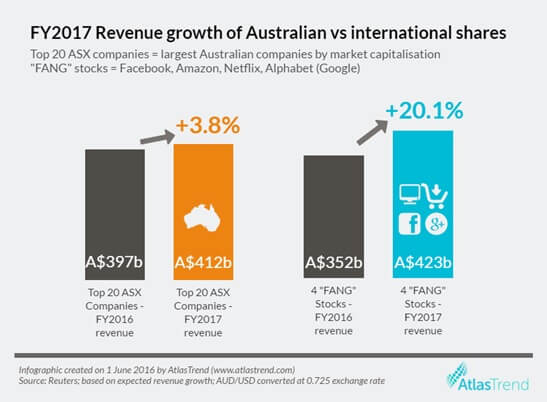
Revenue growth doesn’t always lead to profit growth. However, low or no revenue growth usually makes it much harder to deliver strong profit growth. It is for this reason that many investors prefer investing at least some of their money in faster growing companies.
Unfortunately, as the infographic above shows, the combined revenue growth for the largest 20 companies on the ASX is really quite low. In fact, compared to the FANG stocks (which are four well known technology companies listed in the US), the revenue growth for Australia’s largest 20 companies is very poor. Bear in mind, these 20 companies represent approximately half the entire size of Australia’s share market.
No wonder a number of blue chip ASX companies have recently reduced their dividend payments. It is a clear acknowledgement that they are struggling to find revenue growth faced with either pricing or volume pressures for their products.
In contrast, there are a number of industries and companies overseas that are enjoying strong revenue and profit tailwinds for their businesses. The FANG stocks are just one example out of many other large blue chip international listed companies, which are operating in much better growth environments.
Which type of companies do you prefer investing in?
The ones battling to cut costs in order to protect profits in a low revenue growth environment or instead the companies that are seeing real underlying growth in demand for their products and services.
2. Innovation drives long-term returns but it isn’t a key focus for many Australian companies
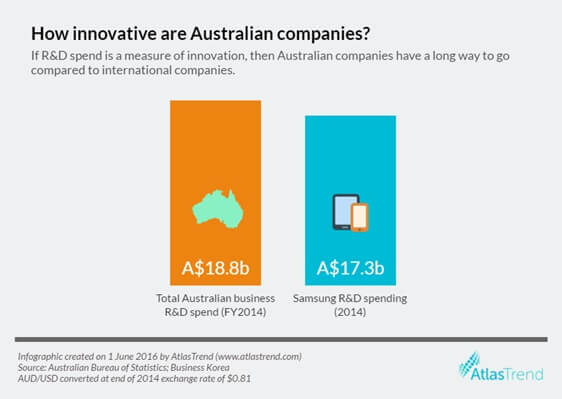
Do you believe innovation drives long-term returns for investors?
If you think about some of the most successful companies that have come along in the past decade, many succeeded by taking an innovation-led approach. Whether it is in online search, social networking, online taxi bookings or car manufacturing, the innovators have generally outperformed.
It is undeniable that the one item that helps drive innovation is spending on research and development (R&D). As you can see from the infographic, the total R&D by all Australian businesses combined is barely more than what one Korean company spends on R&D. It is a clear sign that large Australian companies are not spending anywhere near what international competitors are on R&D and innovation.
Why is this the case?
Looking at the large listed Australian companies, most board of directors are usually hamstrung by a short-term focus on earnings and in particular increasing dividends. This prevents any significant longer-term major R&D projects since they may not produce near term earnings or cash for the company. Where there are examples of innovative companies in Australia, they tend to be small or unlisted.
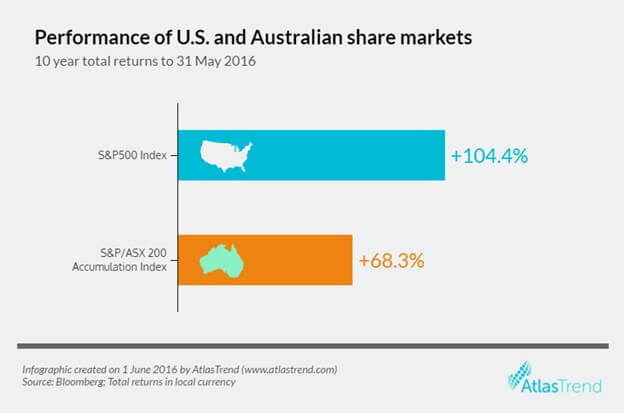
In contrast, it is quite common to see international blue-chip companies earning billions of dollars in profits not pay a single dollar in dividends. These companies have much greater capacity to invest in innovation and grow the long term value of their business rather than focusing on delivering increasing dividends. Don’t take our word for it, have a look at the chart below comparing the total return performance of the US (traditionally low dividend yield) and Australian (traditionally high dividend yield) share markets.
3. Accessing global megatrends requires global investments
Do you believe certain global themes or trends can drive long term investment returns?
For example, the commodities boom which lasted a decade provided great returns for investors in many Australian listed shares. However, with the end of that boom, the next megatrends driving investing returns over the next decade are much harder to get exposure to via blue-chip Australian shares given financial services and resources shares make up approximately 60 per cent the market capitalisation of the S&P/ASX 200 index.
For example, if you believe in the fast growth of online shopping, the exponential power of big data, or perhaps the trend towards autonomous cars, there are virtually no Australian blue-chip listed companies that offer a strong exposure to these megatrends. With the world being increasingly connected, there is no reason to limit your investments to just shares listed on the ASX. If you believe the next set of global megatrends will provide strong positive investment performance, then you should strongly consider investing globally.
4. The Australian dollar is on your side
When investing in international shares, movements in the Australian dollar can have an impact on your investment returns. At times you might be concerned that the Australian dollar may appreciate significantly after investing in international shares, which may lead to overall losses on the investment despite the share price increasing in local currency terms.
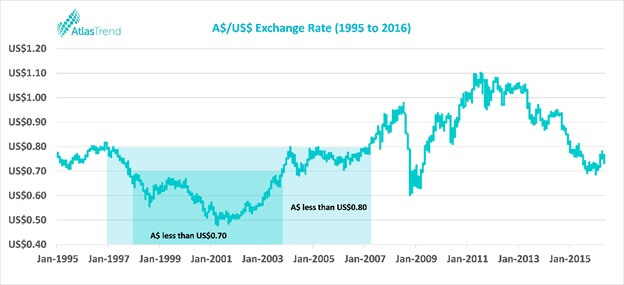
Like all currencies, the Australian dollar reflects the health of the economy relative to other economies around the world. As the chart above shows, although the Australian dollar has declined by over 30 per cent from its highs a few years ago, history suggests that it can remain at the current levels and decline even further for a number of years to come. In fact, unless you believe another Australian industry boom is around the corner, then the chances of the Australian dollar appreciating significantly in the next few years are very low.
5. The diversification benefits are real
Australian listed shares are only 3 per cent of the world’s total listed shares’ market capitalisation. If you believe in the benefits of diversification, investing in international shares and other asset classes can provide you with a better risk adjusted investment portfolio.
Kevin Hua, co-founder, AtlasTrend

Stock market
Russell rebalance reshapes investment landscape amid SpaceX IPO buzz
As the world eagerly anticipates SpaceX's historic initial public offering today, a significant shift is quietly occurring in the financial markets, one that could have profound implications for both ...Read more

Stock market
Franklin Templeton expands active ETF suite with new global equity and income strategies
In a strategic move to broaden its investment offerings, Franklin Templeton has announced the launch of two new active exchange-traded funds (ETFs) on the Australian Securities Exchange (ASX)Read more

Stock market
ASX companies make strides amidst federal budget chatter
In a week dominated by discussions surrounding the recently released FY27 federal budget, the financial landscape witnessed significant activity, particularly among ASX-listed companiesRead more

Stock market
ASX small caps report mixed results amid market optimism
The latest flurry of quarterly activities reports from ASX-listed small cap companies has provided a snapshot of the diverse and dynamic landscape of Australia's financial market. As April came to a ...Read more
Stock market
Adisyn Limited and Brazilian Critical Minerals make significant strides in their respective sectors
In a landscape where Australia's Information Technology sector often plays second fiddle to global giants, Adisyn Limited (ASX: AI1) is making waves with its innovative advancements in graphene ...Read more

Stock market
Australia's ASX 200 Energy Index surges amid Iran conflict
Australia's ASX 200 Energy Index has surged nearly 20% since the onset of the Iran conflict, marking its highest level in three months. This development positions Australia as the only developed ...Read more

Stock market
Webull launches Webull Connect, revolutionising access for Australian financial advisers
In a significant move that marks its entry into the Australian wealth management sector, Webull Securities (Australia) Pty Ltd, a subsidiary of the Nasdaq-listed Webull Corporation, has unveiled its ...Read more

Stock market
Future Generation Global boosts dividends with special payout, marking significant yield increase
Future Generation Global (ASX: FGG) has announced a significant boost to its dividend offerings for the year 2025, delighting shareholders with an increased fully franked full-year dividend and an ...Read more
Stock market
Russell rebalance reshapes investment landscape amid SpaceX IPO buzz
As the world eagerly anticipates SpaceX's historic initial public offering today, a significant shift is quietly occurring in the financial markets, one that could have profound implications for both ...Read more
Stock market
Franklin Templeton expands active ETF suite with new global equity and income strategies
In a strategic move to broaden its investment offerings, Franklin Templeton has announced the launch of two new active exchange-traded funds (ETFs) on the Australian Securities Exchange (ASX)Read more
Stock market
ASX companies make strides amidst federal budget chatter
In a week dominated by discussions surrounding the recently released FY27 federal budget, the financial landscape witnessed significant activity, particularly among ASX-listed companiesRead more
Stock market
ASX small caps report mixed results amid market optimism
The latest flurry of quarterly activities reports from ASX-listed small cap companies has provided a snapshot of the diverse and dynamic landscape of Australia's financial market. As April came to a ...Read more
Stock market
Adisyn Limited and Brazilian Critical Minerals make significant strides in their respective sectors
In a landscape where Australia's Information Technology sector often plays second fiddle to global giants, Adisyn Limited (ASX: AI1) is making waves with its innovative advancements in graphene ...Read more
Stock market
Australia's ASX 200 Energy Index surges amid Iran conflict
Australia's ASX 200 Energy Index has surged nearly 20% since the onset of the Iran conflict, marking its highest level in three months. This development positions Australia as the only developed ...Read more
Stock market
Webull launches Webull Connect, revolutionising access for Australian financial advisers
In a significant move that marks its entry into the Australian wealth management sector, Webull Securities (Australia) Pty Ltd, a subsidiary of the Nasdaq-listed Webull Corporation, has unveiled its ...Read more
Stock market
Future Generation Global boosts dividends with special payout, marking significant yield increase
Future Generation Global (ASX: FGG) has announced a significant boost to its dividend offerings for the year 2025, delighting shareholders with an increased fully franked full-year dividend and an ...Read more