



Invest
Best and worst places to own property revealed
A property research house has released the median house price growth over the last 20 years, revealing the best and worst places to own property.
Best and worst places to own property revealed

A property research house has released the median house price growth over the last 20 years, revealing the best and worst places to own property.

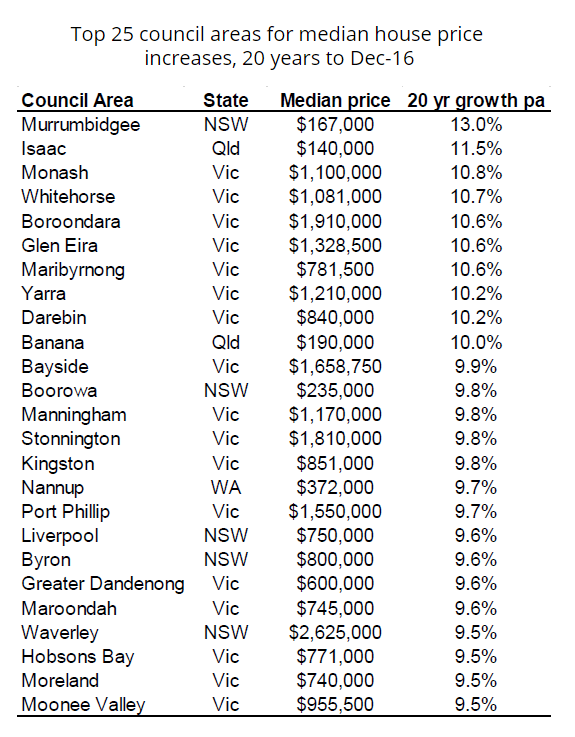
CoreLogic has revealed the top 25 winners and losers in the Australian property game over the last two decades, based on median house price growth.
The top ten, which includes Waverly and Liverpool in Sydney, have enjoyed median prices growing by double-digit annually for the last 20 years.
Inexplicably, it was Murrumbidgee in NSW’s south-west that topped the list with a whopping 13 per cent growth per annum.
“I can’t really explain why Murrumbidgee is the number one performer, although I think the main reason is that prices came off an extremely low base 20 years ago and the fact that during the late 1990s, there was a bit of a boom to that market,” CoreLogic head of research Cameron Kusher said.
Melbourne was the clear winner, claiming six of the top ten areas, including the neighbouring areas of Monash, Whitehorse and Boroondara.
“I think ultimately it’s because we haven't really seen a sustained downturn in the Melbourne housing market for the last 20 years, whereas even though Sydney is very strong at the moment, it and most other capital cities have seen a downturn for at least five years during this time,” Mr Kusher said.
“Melbourne has been the most resilient housing market for the last two decades, not having had a sustained downturn since between 1991 and 1995 when it was coming out of the last recession.”
Victoria was well-represented with 17 of the top 25 areas.
Source: CoreLogic
Meanwhile, the regions of Isaac and neighbouring Banana made up Queensland’s representation in the top 10, despite both suffering recent mining slumps.
“Issac and those kind of areas have had a big downturn in the last five years but still we’ve seen prices come from virtually nowhere and there still much higher than they were 20 years ago,” Mr Kusher said.
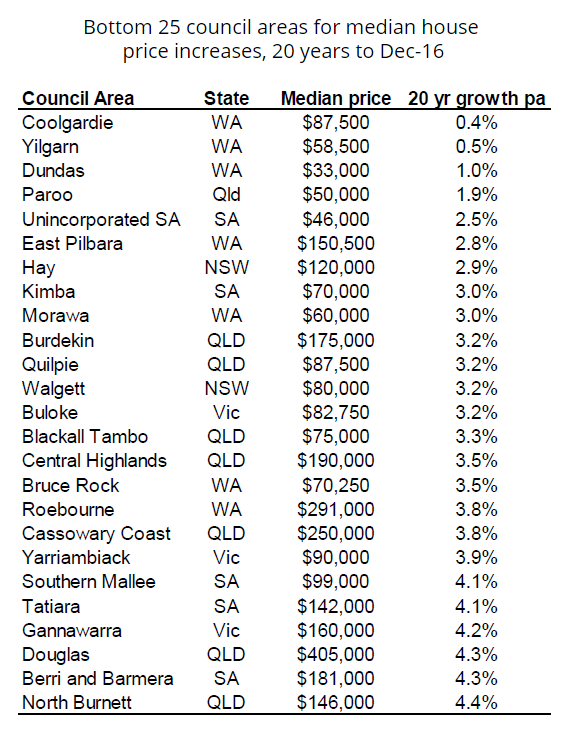
“When you look at the bottom of the list, you can see the effect of the mining boom as well, given the common theme is that most of the worst performers are mining or agricultural areas linked to one or two industries.”
It was no surprise that Western Australia, Queensland and South Australia are home to the 20 worst performers.
Source: CoreLogic
Embattled WA held the worst three performing areas, with Coolgardie, Yilgarn and Dundas scrapping 1 per cent or less annualised growth.
“It was surprising that Coolgardie’s house prices have remained unmoved given it’s next to Kargoolie which is a long-established mining area that hasn’t seen a mining boom or bust,” Mr Kusher said.
“Not one of these worst-performing council areas is situated in a capital city, highlighting that there is often a divide between the performance of capital city and regional housing markets.”

Property
Zagga's ninth anniversary sees focus on investor education in real estate private credit
In a significant milestone, Zagga, a key player in the Australian real estate sector, is celebrating its ninth anniversary with a renewed commitment to investor education. The company has grown ...Read more

Property
Australian property’s quiet pivot: resilience hides a new competitive map
Australia’s housing market remains sturdier than the macro noise suggests, but the sources of resilience have shifted. For operators, the profit pool is migrating from ‘volume at any price’ to ...Read more

Property
Gen Z’s 5% deposit rush: how policy‑driven demand is reshaping Australia’s housing value chain
A government-backed 5% deposit guarantee has triggered a surge in first-home buyer intent among Gen Z, pulling forward demand and resetting competition across banks, brokers and buildersRead more

Property
Cautious bidders, smarter sellers: a Queensland auction case study on repricing risk
Queensland’s auction market has hit a caution cycle as buyers price in higher borrowing costs, global uncertainty and cost-of-living pressure. Clearance softness is forcing agencies to re-engineer ...Read more

Property
Trust, technology and triage: what NSW’s ‘name and shame’ signals for real estate governance
NSW’s latest enforcement action on real estate trust accounts isn’t a one-off embarrassment; it’s a stress test of sector governance. With licences suspended and penalties applied, the message is ...Read more

Property
Vacancy is rising, demand is resilient: A case study in defending yield as Australia’s rental cycle rebalances
After a blistering run, Australia’s rental market is loosening at the edges. Vacancy is edging up off historic lows, rent inflation is set to moderate into 2026, yet underlying demand remains ...Read more

Property
Don’t lose the deposit: A case study in stopping real estate payment fraud — and the ROI for doing it
Deposit redirection scams are quietly eroding buyer savings and agency reputations in Australia’s property market. This case study unpacks how a mid-tier real estate group redesigned its settlement ...Read more

Property
The $12m threshold: Why portfolio value, not property count, now defines Australia’s investor elite
The old yardstick of six properties as shorthand for investment success has been overtaken by a harsher reality: in today’s market, elite status is defined by balance-sheet strength, not asset countRead more
Property
Zagga's ninth anniversary sees focus on investor education in real estate private credit
In a significant milestone, Zagga, a key player in the Australian real estate sector, is celebrating its ninth anniversary with a renewed commitment to investor education. The company has grown ...Read more
Property
Australian property’s quiet pivot: resilience hides a new competitive map
Australia’s housing market remains sturdier than the macro noise suggests, but the sources of resilience have shifted. For operators, the profit pool is migrating from ‘volume at any price’ to ...Read more
Property
Gen Z’s 5% deposit rush: how policy‑driven demand is reshaping Australia’s housing value chain
A government-backed 5% deposit guarantee has triggered a surge in first-home buyer intent among Gen Z, pulling forward demand and resetting competition across banks, brokers and buildersRead more
Property
Cautious bidders, smarter sellers: a Queensland auction case study on repricing risk
Queensland’s auction market has hit a caution cycle as buyers price in higher borrowing costs, global uncertainty and cost-of-living pressure. Clearance softness is forcing agencies to re-engineer ...Read more
Property
Trust, technology and triage: what NSW’s ‘name and shame’ signals for real estate governance
NSW’s latest enforcement action on real estate trust accounts isn’t a one-off embarrassment; it’s a stress test of sector governance. With licences suspended and penalties applied, the message is ...Read more
Property
Vacancy is rising, demand is resilient: A case study in defending yield as Australia’s rental cycle rebalances
After a blistering run, Australia’s rental market is loosening at the edges. Vacancy is edging up off historic lows, rent inflation is set to moderate into 2026, yet underlying demand remains ...Read more
Property
Don’t lose the deposit: A case study in stopping real estate payment fraud — and the ROI for doing it
Deposit redirection scams are quietly eroding buyer savings and agency reputations in Australia’s property market. This case study unpacks how a mid-tier real estate group redesigned its settlement ...Read more
Property
The $12m threshold: Why portfolio value, not property count, now defines Australia’s investor elite
The old yardstick of six properties as shorthand for investment success has been overtaken by a harsher reality: in today’s market, elite status is defined by balance-sheet strength, not asset countRead more